
In the UK, a scuba cylinder needs an internal visual inspection every two and a half years and a full hydrostatic test every five. Miss either date and a responsible fill station will hand your cylinder back empty.
That's the short answer. The longer one covers what the test centre actually does, what the stamps and stickers on your cylinder mean, what it costs, and the habits that decide whether your cylinder passes. It's worth ten minutes, especially at this time of year, when most kit is seeing more of the garage than the sea.
How often does a scuba cylinder need testing in the UK?
The two tests alternate, so your cylinder visits a test centre every two and a half years:
Visual inspection: every 2.5 years
Hydrostatic test (which includes a visual): every 5 years
These intervals come from the British Standard for cylinder inspection, BS EN ISO 18119. Its default is actually an internal inspection every year. The UK keeps the longer 2.5-year gap because the diving industry maintains a risk assessment, reviewed annually, showing that well-cared-for recreational cylinders are low risk.
That detail matters. The longer interval assumes divers look after their cylinders between tests. More on that below.
Is cylinder testing a legal requirement?
For practical purposes, yes. HSE guidance is that inspection and testing rules apply to a recreational diver's cylinder whenever it is filled by someone at work, which covers every dive-centre fill in the country. HSE also strongly recommends testing all cylinders, and notes that insurance may be affected if you don't.
In real life it comes down to this: no in-date test, no fill.
What happens in a visual inspection?
"Visual" undersells it. The cylinder is emptied, the valve comes out, and a trained inspector looks at the bits you never see:
The inside, with a light, for corrosion, pitting and contamination
The outside, for dents, gouges, bulges and corrosion, including under the boot
The neck and valve threads
The valve itself
Older aluminium cylinders get an extra check. HSE has warned about cylinders made from the alloys HE30/AA6082 and AA6351, typically more than 23 years old when the bulletin was issued in 2018. These should only stay in use if they have also passed an eddy-current test. If you've inherited an old ali cylinder, tell us when you drop it off.
What happens in a hydrostatic test?
A hydro includes everything in the visual, then adds a pressure test. The cylinder is filled with water and pressurised to its test pressure, which is stamped on the shoulder and is higher than its working pressure.
Water is used because it barely compresses, so if a cylinder does let go, it does so without drama. A cylinder that passes is stamped on the shoulder with the test centre's mark and the date.
How to read the stamps and stickers
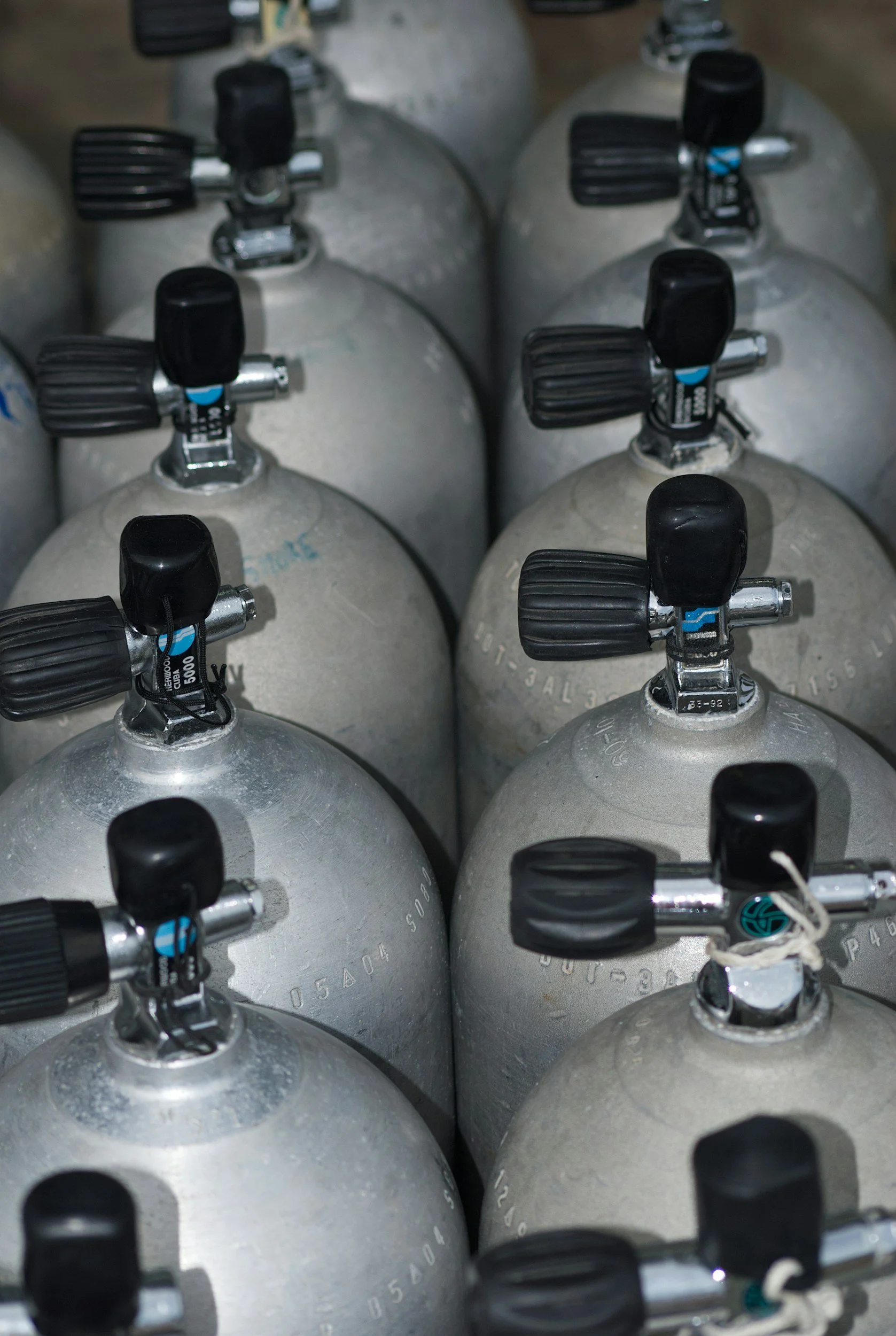
Have a look at the shoulder of your cylinder. Among the stamped markings you'll find:
The original test date, which tells you how old the cylinder is
The working pressure, usually 232 or 300 bar
The test pressure
A new stamp for each hydrostatic test it has passed since
Visual inspections work differently. Since 2019, IDEST test centres no longer stamp the metal after a visual. Instead you get a quadrant label showing which test was done and the month and year the next one is due.
Keep your test certificate somewhere safe. If the label gets scraped off in a boat rack, the certificate is your proof.
Seven common cylinder mistakes
1. Thinking the visual is annual. A lot of what you read online is written for the United States, where yearly visuals are the norm. The UK interval for recreational cylinders is 2.5 years.
2. Assuming "in test" means "safe". HSE is blunt about this. If fresh water gets inside a steel cylinder, corrosion can remove more than 2 mm of wall thickness in six months, and more in salt water. Cylinder walls are generally only 2 to 5 mm thick, and there are often no signs on the outside.
3. Running it empty. Breathing a cylinder right down, or draining it for storage, is how water gets in. Industry guidance is to keep at least 2 bar inside. A cylinder that arrives with no pressure at all has to be internally examined before it can be filled.
4. Never taking the boot off. Salt water sits under there for months. Pull the boot off now and then, rinse and dry.
5. Buying second-hand without reading the shoulder. Check the age, the alloy and the test history before you hand over cash. A cheap cylinder that needs a hydro and an oxygen clean, and might fail anyway, is not a bargain.
6. Forgetting Nitrox is separate. A cylinder that is in test for air is not automatically ready for enriched air. For Nitrox fills it must be oxygen clean and clearly marked for enriched air use. An O₂ clean is due every year, so it comes round more often than the tests.
7. Assuming a missed visual means an automatic hydro. Not necessarily. IDEST guidance shared by BSAC is that a visual can still be carried out if you're up to 18 months overdue, although a hydro makes sense if the next one is close. The test centre will advise.

Looking after your cylinder between tests
The 2.5-year interval depends on these habits, so they're worth forming:
Finish every dive with gas left in the cylinder
Open the valve briefly to blow out any water before fitting your regulator or having it filled
Dry the valve after diving and keep it capped when no regulator is attached
Store it with a little pressure inside and the valve closed
If you think water may have got in, have it checked before the next fill, whatever the label says
Small cylinders deserve extra attention. Pony bottles, suit inflation and DSMB cylinders are emptied more often, which puts them at higher risk of water getting in.
What it costs and how long it takes
We're the booking and drop-off point here at Littlehampton Marina, and cylinders go to an IDEST-approved test centre. Current prices are:
Visual inspection: £65
Hydrostatic test: £75
Visual inspection with O₂ clean: £75
Hydrostatic test with O₂ clean: £85
O₂ clean and valve service only: £50
Internal shot blast or deep clean: £35
Standard turnaround is 10 to 14 working days. In busy periods it can be up to four weeks, and we can't guarantee a completion date.
That's the case for doing it in winter. It's a familiar story at any dive centre: the out-of-date label discovered the night before the first decent weekend of the year. Count back from your first planned dive and give yourself a month.
For divers in Worthing, Bognor Regis and Chichester, we're a short drive with free parking outside the door. When your cylinder comes back you can have it filled here too, with air to 232 or 300 bar, or Nitrox.
Check your cylinder tonight
Go and read the shoulder stamp and the label. If either date falls before your first dive of next season, book your cylinder in now and it will be ready when the water is.
Call us on 01903 962602, email info@abyss-scuba.co.uk, or book through our equipment servicing page.
